Warehouses and logistics centers play an important role in Pakistan’s commercial and industrial supply chain. These facilities support storage, distribution, inventory management, packaging, loading, cold-chain operations, and transportation networks.
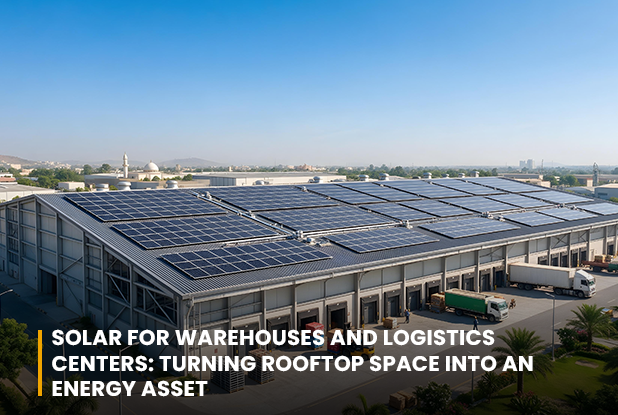
Because warehouses often have large rooftops and steady daytime electricity usage, they are ideal locations for commercial solar systems. Instead of leaving rooftop space unused, businesses can turn it into a productive energy asset that reduces electricity costs and supports long-term operational efficiency.
For warehouses, distribution centers, and logistics businesses, solar energy can help power lighting, ventilation, office areas, security systems, loading docks, refrigeration units, IT systems, and material handling equipment.
Beacon Energy provides smart commercial and industrial solar solutions designed for businesses across Pakistan.
2. Why Warehouses Are Ideal for Solar Energy
Warehouses and logistics centers usually have wide, open rooftop areas that can be used for solar panel installation. These rooftops often receive strong sunlight during the day, making them suitable for generating clean electricity on-site.
Many warehouse operations also consume electricity during daylight hours. Lighting, fans, ventilation, CCTV cameras, office equipment, scanners, internet systems, and loading operations often run throughout the working day. This makes solar energy highly practical because generation and consumption happen at the same time.
For businesses with large facilities, rooftop solar can reduce dependency on grid electricity and make better use of existing infrastructure.
Companies can explore Beacon Energy’s Industrial & Commercial Solar Solutions for solar systems designed for warehouses, logistics centers, manufacturing units, retail spaces, cold storage facilities, and other high-consumption businesses.
3. How Solar Reduces Warehouse Electricity Costs
Electricity costs can be a major operating expense for warehouses and logistics centers. Large indoor spaces require lighting, ventilation, security systems, office operations, and sometimes temperature control.
A commercial solar system helps reduce electricity bills by generating power during the day. When solar panels produce electricity, the facility can use that energy directly instead of purchasing all power from the grid.
This can create long-term savings and make energy expenses more predictable. For logistics companies managing multiple sites, solar can also support better cost control across their network.
Solar energy can be especially useful for warehouses with daytime operations, high lighting demand, refrigeration needs, or electric equipment usage.
4. Role of BESS in Warehouse and Logistics Energy Management
Solar energy can reduce daytime electricity costs, but Battery Energy Storage Systems, also known as BESS, can provide additional value for warehouses and logistics centers.
BESS stores electricity and supplies it when needed. For warehouses, battery storage can support essential systems during outages, peak demand periods, or unstable grid conditions.
Important backup loads may include security systems, CCTV cameras, fire safety systems, access control, IT servers, internet systems, emergency lighting, cold-chain storage, and selected operational equipment.
A solar-plus-BESS system can help logistics businesses reduce generator dependency, improve power reliability, and protect critical operations during load shedding or unexpected outages.
Businesses can learn more about Beacon Energy’s BESS solutions for energy storage, backup power, and commercial energy management.
5. Benefits of Solar for Warehouses and Logistics Centers
Solar energy offers several benefits for warehouses and logistics facilities in Pakistan.
The first benefit is reduced electricity cost. Solar allows businesses to generate power on-site and reduce grid consumption during daytime operations.
The second benefit is better use of rooftop space. Warehouses often have large roofs that can be converted into productive solar assets without requiring additional land.
The third benefit is improved energy reliability when solar is combined with BESS. Battery storage can help keep critical systems running during power outages and reduce operational disruption.
The fourth benefit is lower generator usage. Solar with battery storage can reduce reliance on diesel generators, helping businesses lower fuel costs, noise, maintenance, and emissions.
The fifth benefit is sustainability. Logistics companies and warehouse operators can reduce their carbon footprint and improve their environmental profile by adopting renewable energy.
Businesses can also review Beacon Energy Projects to explore commercial and industrial solar installations across Pakistan.
6. Beacon Energy for Warehouse Solar Solutions
Warehouses and logistics centers need energy systems that are designed according to their facility size, rooftop condition, electricity usage, operating hours, backup requirements, and long-term business goals.
Beacon Energy helps commercial and industrial businesses plan solar systems built for performance, reliability, and savings. For warehouses and logistics centers, Beacon Energy can support solar system design, rooftop assessment, BESS integration, monitoring, and long-term energy optimization.
Warehouse operators and logistics businesses can explore Industrial & Commercial Solar Solutions, learn more about BESS solutions, review Beacon Energy Blogs, or contact Beacon Energy for project consultation.
With the right solar and storage system, warehouses and logistics centers in Pakistan can reduce electricity costs, improve energy reliability, and turn unused rooftop space into a valuable long-term energy asset.