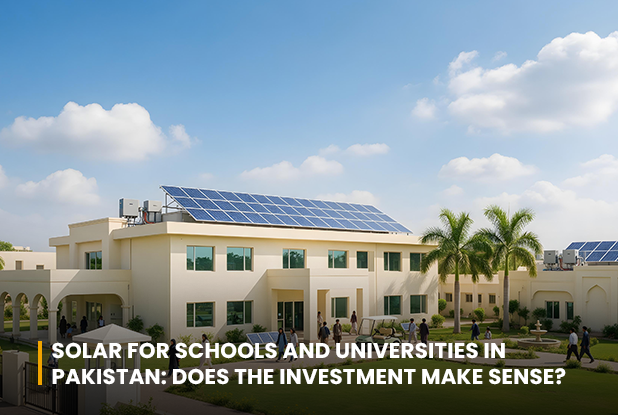
Schools and universities in Pakistan require reliable electricity every day. Classrooms, computer labs, libraries, laboratories, offices, hostels, auditoriums, security systems, fans, lighting, air conditioning, and internet infrastructure all depend on continuous power.
At the same time, electricity costs are becoming a major financial burden for educational institutions. Higher utility bills can affect operating budgets, maintenance planning, student facilities, and long-term development.
This is why many schools, colleges, and universities are now considering solar energy. A properly designed solar system can reduce electricity bills, improve energy reliability, and support a cleaner campus environment.
For educational institutions looking for reliable solar solutions, Beacon Energy provides smart commercial and institutional energy systems across Pakistan.
2. Why Solar Makes Sense for Educational Institutions
Schools and universities usually operate during daylight hours, which makes solar energy highly practical. Solar panels generate electricity during the day, the same time when classrooms, offices, labs, and campus facilities are actively using power.
This means solar energy can be used directly during school or university operations. Instead of depending completely on grid electricity, educational institutions can generate a portion of their own power on-site.
Solar can support daytime loads such as lighting, fans, air conditioning, computer labs, projectors, administrative offices, water pumps, and security systems. This helps reduce grid consumption and lowers monthly electricity costs.
Educational institutions can explore Beacon Energy’s Industrial & Commercial Solar Solutions for customized systems designed for schools, universities, commercial buildings, and institutional campuses.
3. Cost and ROI Considerations
The investment in solar depends on several factors, including electricity consumption, available rooftop space, campus size, system capacity, equipment quality, and backup requirements.
For schools and universities, solar should be viewed as a long-term investment rather than a short-term expense. The system can continue generating electricity for many years, helping the institution reduce operating costs over time.
A proper feasibility assessment should review electricity bills, daytime usage, roof condition, available open space, and future expansion plans. Institutions with high daytime electricity usage are often better positioned to benefit from solar.
If backup power is also required, schools and universities can consider battery storage. Beacon Energy’s BESS solutions can help store energy and provide support during outages or unstable grid conditions.
4. Benefits of Solar for Schools and Universities
Solar energy offers several benefits for educational institutions in Pakistan.
The first benefit is reduced electricity cost. Solar helps schools and universities lower grid electricity consumption during the day, which can reduce monthly utility bills.
The second benefit is better budget planning. Lower and more predictable energy expenses allow institutions to allocate more resources toward academic programs, student services, facility improvements, and campus development.
The third benefit is improved power reliability when solar is combined with battery storage. A solar-plus-BESS system can support critical loads such as computer labs, security systems, internet equipment, administrative offices, and essential lighting during outages.
The fourth benefit is sustainability. Solar energy helps institutions reduce their carbon footprint and promote environmental responsibility among students, parents, faculty, and the wider community.
The fifth benefit is educational value. A campus solar system can also become a real-world learning example for students studying science, engineering, sustainability, environmental studies, or business management.
Institutions can also review Beacon Energy Projects to explore commercial and industrial solar installations across Pakistan.
5. Solar with BESS for Campus Energy Resilience
A standard solar system can reduce electricity bills, but a solar system with BESS can provide stronger energy resilience.
BESS stores electricity and supplies it when needed. For schools and universities, stored energy can support essential systems during outages, load shedding, or grid instability.
Critical campus loads may include emergency lighting, internet systems, computer labs, CCTV cameras, security systems, water pumps, administrative offices, and selected classroom areas.
Battery storage can also reduce generator dependency. Many educational institutions rely on diesel generators during outages, but generators come with fuel costs, maintenance needs, noise, and emissions. Solar with BESS can reduce generator usage and provide a cleaner backup option.
Schools and universities can learn more about Beacon Energy’s BESS solutions for backup power and energy storage support.
6. Beacon Energy for School and University Solar Solutions
Solar investment can make strong sense for schools and universities in Pakistan when the system is planned correctly. The key is to design the system according to actual electricity usage, available space, operating hours, backup needs, and long-term institutional goals.
Beacon Energy helps commercial and institutional customers plan solar systems built for performance, savings, and reliability. For schools, colleges, and universities, Beacon Energy can support solar system design, installation planning, BESS integration, monitoring, and long-term energy optimization.
Educational institutions can explore Industrial & Commercial Solar Solutions, learn more about BESS solutions, review Beacon Energy Blogs, or contact Beacon Energy for project consultation.
With the right solar and battery storage system, schools and universities in Pakistan can reduce electricity costs, improve campus reliability, support sustainability, and make a smart long-term investment in their future.